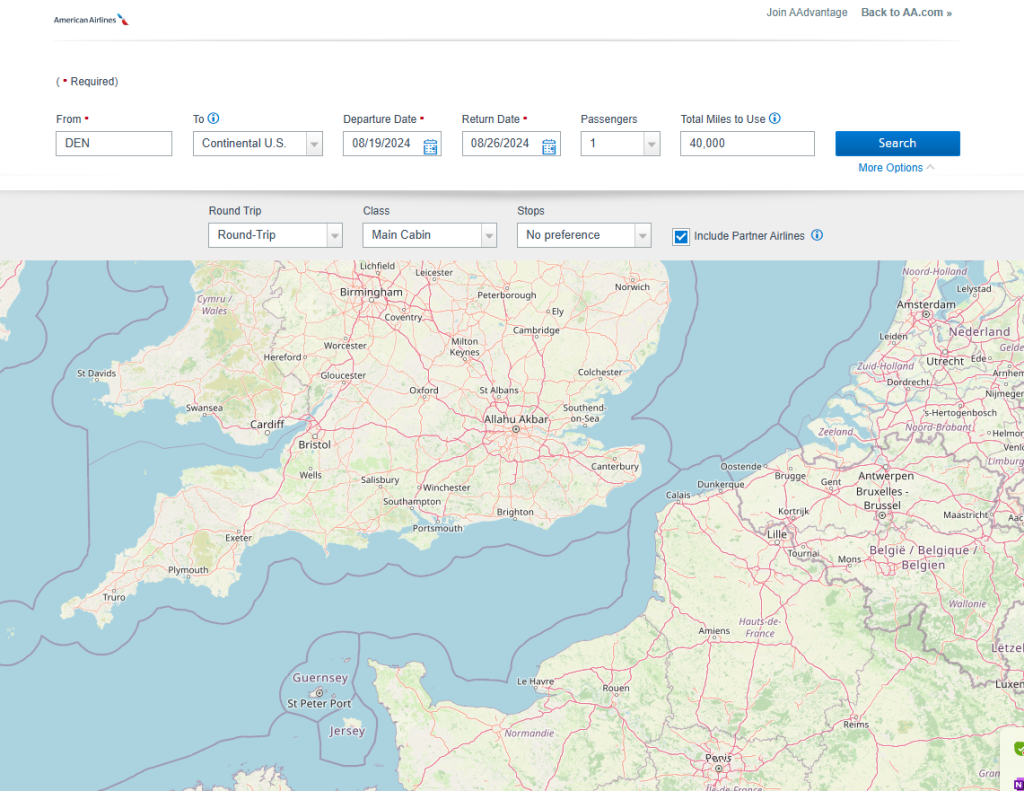
American Airlines’ Award Map tool has become an essential resource for travelers seeking to book award flights. However, users are noticing something unusual tonight: some European capitals are appearing with incorrect and offensive names.
If you zoom in and out at very specific levels, you’ll see London listed as “Allahu Akbar,” and Paris labeled with a term referring to male anatomy. It’s worth noting that while “Allahu Akbar” isn’t inherently an offensive term, one can safely assume whoever uploaded this edit likely didn’t do so with good intentions.
Offensive names shown on AA Award Map in place of European capitals (C) 2024 Points & PDBs
Now before we start staging boycotts of AA, let’s examine the facts. As an IT professional, I can tell you this isn’t a direct failure of American Airlines. The tool relies on data from OpenStreetMap, a community-driven geographic database similar to Wikipedia (but for mapping!), where edits can be made by volunteers – in fact, Wikipedia features OpenStreetMap data within many articles, and you can log in to edit OpenStreetMap with your Wikipedia credentials! I went straight to the source to confirm that OSM was showing the same data, and sure enough, there it was, clear as day.
Right from the source… (C) 2024 Points & PDBs
OpenStreetMap’s open-source nature allows for this kind of mischief, and while AA has been caught in the crossfire, I wouldn’t point fingers directly at the airline in this instance. That said, one has to question the wisdom in using mapping data sourced from the general public (and editable at any time!) on a production, public-facing tool. That, to me, just seems like asking for trouble. Even when I was a student at Oklahoma State, publicly-editable sources like Wikipedia were never acceptable to cite in one’s own work, due to the possibility of inaccuracies. Pony up & partner with a more professional source such as ArcGIS, where the data can’t just be edited by anyone with an Internet connection.
All that said, I’d hate to be on AA’s PR team tonight…
American Airlines has announced some changes to its AAdvantage program that will affect how you earn miles and Loyalty Points on flights, depending on where you book.
Starting with tickets issued on May 1, 2024, you will only earn miles and Loyalty Points on flights when you:
Book directly with American and eligible partner airlines.
Book travel anywhere as an AAdvantage Business member or contracted corporate traveler.
Book through preferred travel agencies. American will share a list of eligible preferred agencies on aa.com in late April.
This means that if you book through a third-party site like Expedia, Orbitz, or Priceline, you will not earn any miles or Loyalty Points on your flights. American says this is to “provide the best possible experience” and “reward our AAdvantage members”7. I say this is to discourage customers from shopping around for the best deals and to push them to book directly with American, where they can charge higher fares and fees.
Basic Economy fare tickets will only earn when booked directly with American and eligible partner airlines – the key distinction here from “normal” economy being that it seems even bookings made with an accredited corporate travel agency won’t earn miles or LPs.
Of course, for most of us, booking direct is the way to go anyway, unless you are forced to use a corporate travel agency. It’s so much easier in the event of irregular operations (IRROPS) to just work directly with the airline to fix things, rather than trying to work through a third-party. Which would you rather do… wait on hold for 6 hours to speak to a third party who may or may not be familiar with airline policies? Or stop by a ticketing/customer service desk (or even the Admirals Club)?
Until now, however, there hasn’t been any real penalty to booking flights with an OTA (so long as nothing goes wrong). Hotels have been a different story for a long time. None of the “majors” will typically grant any points or elite credit/recognition on a third-party booking, unless that third party is an accredited corporate travel agency. Back in 2018, Hyatt Place even experimented with restricting its complimentary breakfast only to World of Hyatt members who booked direct (though that’s hardly a loss given the breakfast quality at your typical neighborhood Hyatt Place). Hyatt suspended this policy during the pandemic, and there’s currently no reason to think it’ll be reinstated anytime soon; the mediocre breakfast product just isn’t worth the manpower to protect, I guess!
The message from AA is clear: book direct, or else. The major airlines tend to move in lockstep with each other, so time will tell if this is just an AA thing, or an industry-wide shift. What do you think of these changes? Will they affect how you book your flights with American?
So, you think you’ve seen it all when it comes to bizarre incidents during flights? Well, buckle up, because this one might shock even the most seasoned flyer (and we know a thing or two, because we’ve seen a thing or two). A recent Reddit post on the r/americanairlines community shared an eyebrow-raising tale that’ll have you questioning your fellow passengers’ sanity – or at least their understanding of acceptable carry-on items.
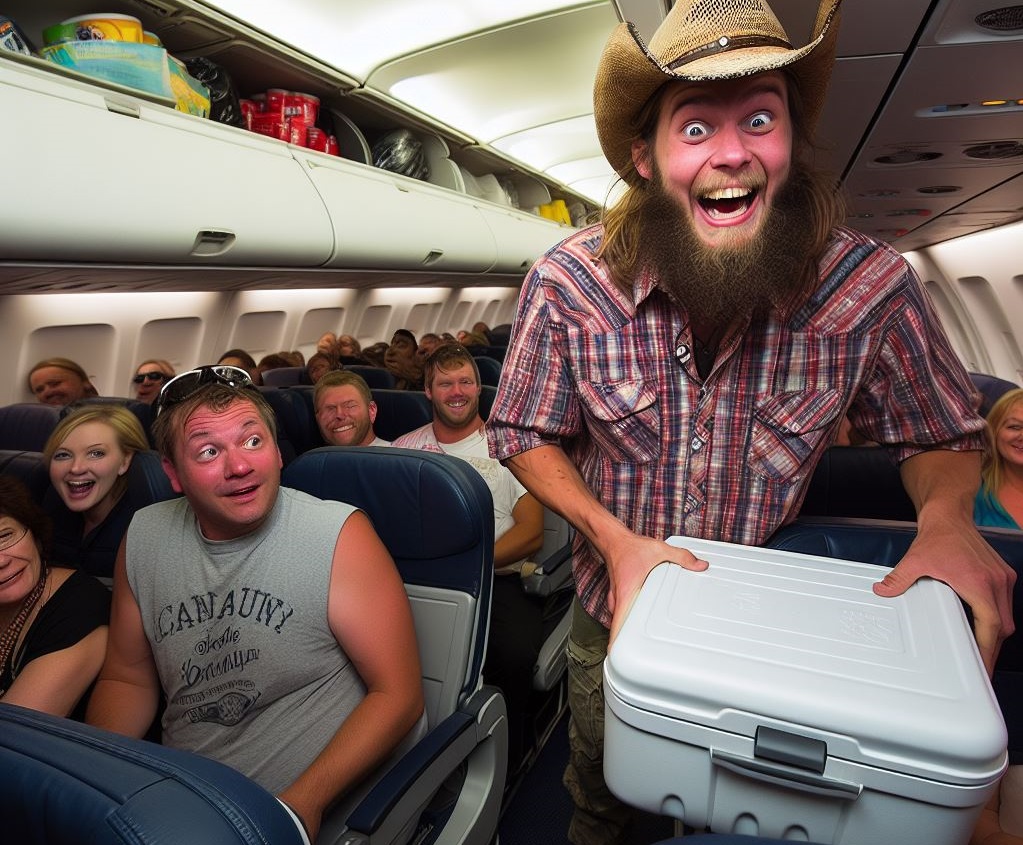
User BackNBlack58 took to the internet with a public service announcement that’s as absurd as it is cautionary: “PSA dont bring dead animals in a cooler in your carry-on.” Yes, you read that right. Someone apparently did just that on a recent American Airlines flight. Eww!
According to the post, a flight had to make an unexpected U-turn on the tarmac due to the presence of a cooler housing a deceased bird. Not only did the bird-in-a-box cause a mid-air spectacle, but it also managed to turn the overhead compartment into a scene from a particularly strange horror movie. The cooler’s contents spilled out, prompting the pilot to declare it a biohazard (subsequently causing the pilot to be awarded the title of “Captain Obvious”).
Of course, the internet being the internet, one witty commenter couldn’t resist adding a dash of humor to the situation. User bbphrog63 chimed in with a quip, saying, “Guess they misunderstood carrion luggage.” Well played, bbphrog63, well played.
Now, for those of you questioning the legality of transporting deceased creatures through the friendly skies, the truth might surprise you. Believe it or not, according to TSA regualations, it’s generally permissible to bring dead animals on a plane. However, the key here is a little thing called common courtesy – and airline rules, too.
Sure, the regulations might give you the green light, but that doesn’t mean you should start packing your carry-on cooler with that roadkill you found on the highway or anything that might unleash itself mid-flight. The intent of the TSA allowing this is, for example, the transportation of cremated pet remains, or frozen animals (we’d suggest making sure it’s cold enough to remain frozen throughout your entire journey, and taking a nonstop flight). Let’s keep it real, folks – a little consideration for your fellow passengers goes a long way. And while the TSA may not stop you from bringing a deceased animal on your flight, your airline still has the final say here, so you should always discuss your situation with them prior to showing up at the airport with a cooler.
So, the next time you’re contemplating bringing your hunting trophy on board, remember the tale of the ill-fated bird cooler, and maybe pick a container that seals a little bit tighter than a MAX 9 fuselage (or just consider driving to your destination if possible). Because in the grand scheme of air travel, we could all use a bit less drama and a lot more common sense. Until then, happy flying, and may your overhead compartments remain critter-free.
You either love or hate the Admirals Club at DFW Terminal C. It’s giant, and it’s dated. If you ever wanted to know what it was like to be George Clooney’s character in Up in the Air, this club could likely give you a pretty good idea. The food selection is abysmal, but at least there are plenty of places to hide out, including full-height cubicles in the business center. Even though the terminal has largely been relegated to domestic flights to secondary markets like Oklahoma City (OKC), they’ve never removed the shower facilities from the terminal – something CLT doesn’t have at either of their Admirals Clubs.
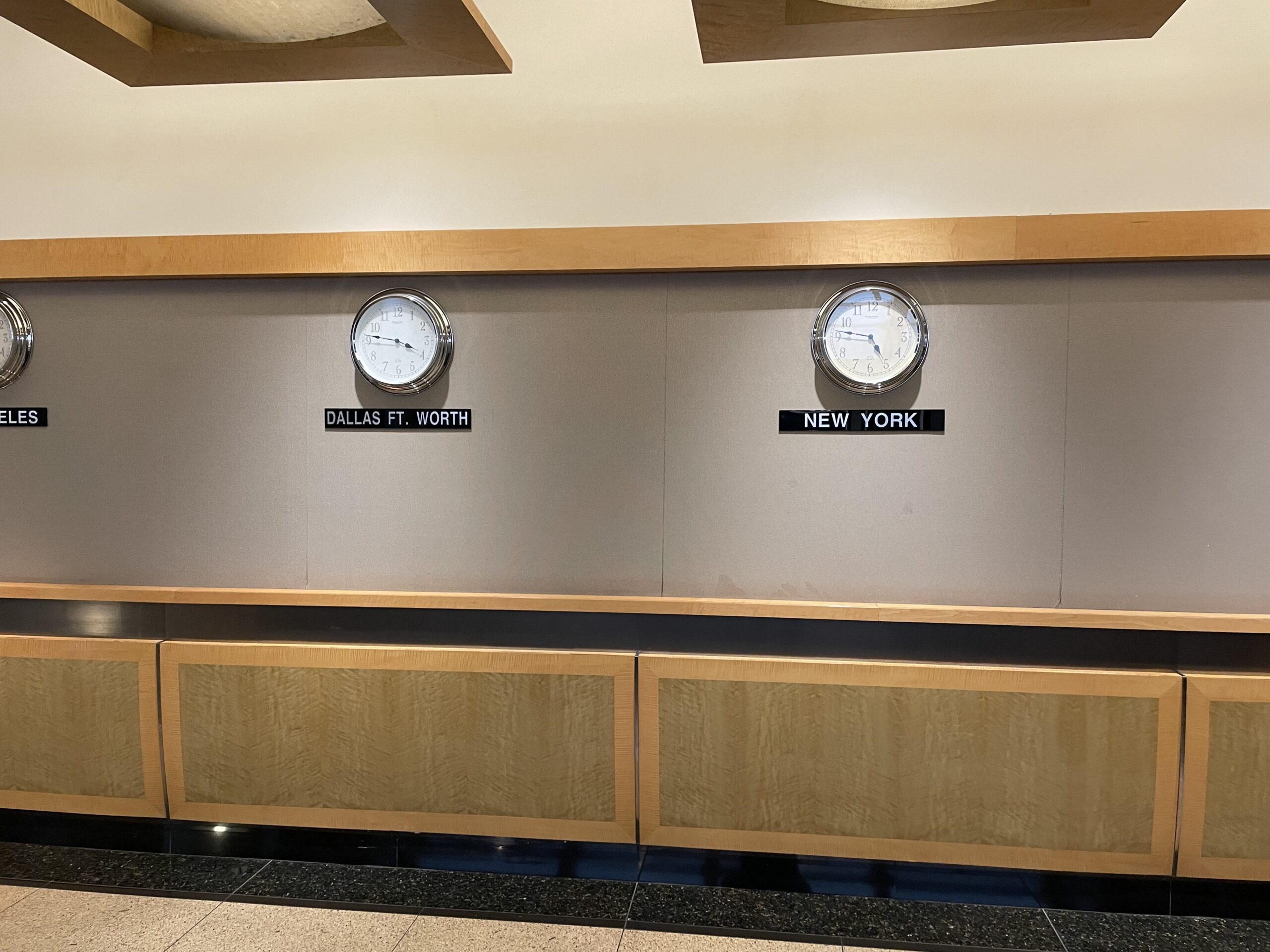
World clocks… how very… retro!
Well, there’s one interesting feature of this club that AA desperately needs to update. You see, it’s been years since AA changed its policy on gate closure, requiring passengers to be in the gate area available for boarding no later than 15 minutes, in its endless and well-documented quest to achieve D0 at all costs. However, signage at various points throughout the facility paints a different picture.
What’s wrong with this picture? These signs state AA’s previous policy of gate closure at just 10 minutes prior to departure, not 15.
This is dangerous to have posted prominently throughout the club. People like to enjoy the lounge until the last possible second, and 5 minutes can make all the difference between making your flight and missing it. I guess AA assumes most people enjoying an Admirals Club are probably frequent enough flyers to know better. But one has to wonder how many infrequent travelers have been burned by this; I’m imagining someone going on a once-in-a-lifetime trip on a business class ticket, or someone on a long delay purchasing a day pass when those are actually offered for sale.
As that terminal is rebuilt piece by piece (and it will be stunning once complete), I can’t see AA investing another dime into that club unless absolutely necessary; everything is being rebuilt anyways, so why would they? Regardless, maybe if they don’t want to paint over the paint damage from removing these signs, maybe they can at least have some new ones printed? This would be forgivable if it hadn’t been many years since this change was made… but in 2023? C’mon, AA…
Last week, we told you about AA flight attendants’ plans for a potential strike during the busy Christmas travel season. Just as we expected, the Association of Professional Flight Attendants (APFA) today officially requested permission from the Biden administration to go on strike, as contract negotiations with American Airlines remain deadlocked. The president of the APFA made the announcement on Monday, stating that she had written to the National Mediation Board (NMB) seeking approval to enter a 30-day cooling-off period as mandated by the Railway Labor Act (which despite the name, also applies to air transport).
Under the provisions of this act, flight attendants must secure permission to enter a cooling-off period before they can legally engage in any “self help” action, such as walking off the job. It’s uncertain when exactly we’ll see a formal response with a yay/nay decision from the NMB, but it’s highly unlikely we’ll see anything immediate, most likely foiling plans for the strike to take place during the busy Christmas travel season. Realistically, it could be early 2024 before we even see a formal response.
Julie Hedrick, the APFA National President sent a letter to the National Mediation Board on Monday, November 20 requesting a release into a thirty day cooling off period. This represents the next phase in our comprehensive campaign for a new contract.
The big question of course is when will the NMB act upon our request? The answer is we do not know. There is no set timeframe for the NMB to act on our request as the decision to release us is solely within the discretion of the mediation board. While we understand this can be frustrating it is the process under the Railway Labor Act.
APFA Press Release
It’s unlikely a strike would completely shut down the airline, if it’s even approved at all. Even if the NMB grants approval, the Biden administration could impose restrictions or mandate minimum service levels to mitigate the impact on the public. We expect disruptions to be more akin to that of a large weather system snarling travel across the US – only this disruption will only impact AA.
AA flight attendants, while earning a base pay comparable to their Delta counterparts, face disparities in profit-sharing due to AA’s less robust financial performance. Factors such as AA’s substantial debt load from maintaining the youngest fleet among major carriers, and a less expansive international route network all contribute to the airline’s financial challenges. While AA is not a low-cost carrier, it currently faces some of the same financial challenges LCCs are up against.
Namely, domestic travel is way off, while international demand remains robust. AA has a very strong domestic route network focused on fortress hubs such as Dallas-Fort Worth (DFW) and Charlotte-Douglas (CLT). However, they are severely lacking on international routes; during the pandemic, they retired older 757s and 767s, anticipating that the Boeing 787 Dreamliners they’d ordered would materialize by the time travel made a meaningful return. Boeing, however, has dropped the ball on delivering these 787s in a timely manner, giving an advantage to Delta and United, who have largely held onto their older widebodies.
I’m honestly skeptical we will see a strike materialize at all, over Christmas or otherwise. Despite the Biden administration’s friendly stance towards unions, the administration has a track record of intervention at the 11th hour to prevent significant disruptions to essential services. We’ve already narrowly avoided a UPS strike, as well as a freight rail strike that would have made getting essential goods and even clean water extremely difficult. I don’t see why it would be different this time. That said, the uncertainty alone could impact AA’s bottom line, as passengers book travel with competitors for greater certainty of their plans.
This labor dispute places President Biden in a delicate position, balancing his pro-union image with the need to avoid being associated with disrupting Christmas travel plans, especially after the challenges faced by that other Dallas-based airline during last year’s Christmas season. While concerns linger, historical patterns suggest that, if a strike becomes imminent, resolution may be reached at the eleventh hour.
American Airlines cabin crews have been deadlocked for quite some time in negotiations over a new contract. Recently, APFA union members voted overwhelmingly in favor of authorizing a strike. Now, the APFA plans to make an announcement on Monday, per an email blast sent out to its members and obtained by Gary over at View From the Wing.
Negotiations Update #38: An Update on This Week’s Bargaining
Your APFA Negotiating Committee met this week with the Company in federal mediation with the National Mediation Board (NMB).
As we indicated in our previous hotline, we have set this week as a deadline for the Company to make significant movement toward reaching an agreement. This afternoon, your APFA Negotiating Committee met with your Board of Directors to brief them on the status of negotiations, including the next step: a request to the National Mediation Board to release us into a thirty-day cooling-off period.
On Monday, November 20th, we will communicate information regarding this week’s negotiations and next steps, including the APFA Board of Director’s action on the request to the NMB to be released to strike. This will allow ample time to prepare communications for the various interested parties, including the National Mediation Board, the Membership, and the media.
Email from APFA Negotiating Committee
Let’s unpack this. First of all, AA flight attendants earn base pay comparable to Delta’s cabin crews. However, profit sharing is a very different story, and that’s simply because AA isn’t nearly as profitable. There are a few reasons behind this:
AA has the youngest fleet of any major US carrier. This is great in terms of passenger experience – I’d much rather fly aboard a 787 Dreamliner than a tired old 757 or 767, of which Delta has 121 and 65, respectively, still active in their fleet. That said, with all these new aircraft comes a much larger debt load, and that’s gotta be serviced.
Delta’s credit card partnership with AmEx sees 1% of the entire United States GDP spent on their cards. Their SkyMiles program is so popular that they’ve had to gut it severely as it has been a victim of its own success (though CEO “Fast Eddie” Bastian had to partially roll the changes back, as too many elites got spooked). US airlines don’t make the bulk of their profits from actually flying planes – they make it through credit card partnerships with AmEx, Citibank, JPMorgan Chase, and so on.
Domestic travel is basically evaporating before our eyes, while international remains robust. American has a really strong domestic route network, but their international network is far behind Delta’s. During the pandemic, AA got rid of a large chunk of their widebody fleet, expecting that by the time international travel returned in any meaningful way, they’d be taking deliveries of shiny new 787s from Boeing. Well, Boeing can’t seem to deliver on that, and until they do, AA’s international network will continue to be severely constrained. It seems like right now, you can fly AA metal to any destination in Europe, as long as it’s Heathrow.
So will we actually see a Christmas strike materialize? The Biden administration has been more friendly to unions than perhaps any other presidency in recent memory. We have come dangerously close to a UPS strike and a freight rail strike, either of which would have made obtaining essential goods and even clean water significantly more difficult. However, in both cases, the strikes were averted at the 11th hour. Unlike in Europe, we are culturally much more averse to allowing essential infrastructure to be disrupted by a strike.
Specifically for this case, it seems the APFA is aiming to formally ask the National Mediation Board on Monday to release them from negotiations, beginning a 30-day cooling off period. A few outcomes could come of this:
They’re asking this during another holiday period – Thanksgiving. I don’t forsee AA getting an answer until sometime in early December, which would push any possibility of a strike into the new year.
The NMB could decline to authorize the cooling-off period, requiring union members to stay at the bargaining table.
In the unlikely event the union obtains timely authorization from the NMB, the ball is in President Biden’s court. This puts Biden in a precarious position. Biden is up for re-election in less than a year, and primary season is coming much sooner than that. Biden needs to maintain his pro-union image going into election season. At the same time, he won’t want to be remembered for ruining Christmas, especially as many Christmases were ruined last year by another Dallas-based airline.
It’s also important to note that it’s unlikely AA cabin crews will shut down the entire airline if and when they do go on strike. They will probably “walk out” on selected flights, causing disruption more akin to that of a major winter storm. Regardless, it would cause severe reputational harm to AA, prompting passengers to consider flying with competitors.
Personally, I’m not too worried about this. History has shown that under the Biden administration, these strikes tend to get averted – albeit typically at the 11th hour. If nothing else, expect that if a strike does happen, it won’t be until early 2024.
Many of us remember back in July when Tiffany Gomas had her outburst on an American Airlines flight out of DFW to Orlando (MCO). Well, Gomas is back at it, this time on… Glenn Beck’s The Blaze? Oh, and she’s apparently banned from AA, too.
Gomas appeared on Prime Time with Alex Stein, and we’ll just let these video clips speak for themselves.
Alex Stein, also known as Prime Time #99, is an interesting character. He’s a right-wing comedian, based in the Dallas-Fort Worth Metroplex. Stein rose to fame (infamy?) by trolling city council meetings, originally around the Metroplex and eventually around the country. Usually citizens are entitled to a set number of minutes to speak before a city council, and Stein would use his alotted time to perform politically-charged raps.
Gomas conveniently also resides in the DFW area, having graduated from my alma mater, Oklahoma State. Assuming her degree is in Marketing, that would mean we both attended the Spears School of Business, and we likely had the same grouchy old Marketing professor at some point (this man also taught Garth Brooks).
If you must, you can watch all 66 minutes of the episode in its full glory on YouTube.
A recent incident reported in the New York Post involving American Airlines has stirred outrage and allegations as a Florida mother, Amber Vencill, took legal action against the airline, claiming they mishandled the travel of her two young sons. According to a lawsuit filed on October 31, Vencill’s 10- and 12-year-old sons, identified as RV and JV in court documents, were left in distressing conditions after their flight got canceled while they were using the airline’s unaccompanied minor service.
Originally scheduled to fly from Missouri to upstate New York with a layover in Charlotte, the boys found themselves in a bewildering situation as their flight faced delays and ultimately cancellation. This unexpected turn left Vencill’s partner, identified as Ted, with a concerning message from the airline, assuring the children would be placed in a “nice room for unaccompanied minors,” equipped with beds and a private bathroom.
Unfortunately, the actual experience the children faced sharply contrasted with the promised arrangements. The lawsuit alleges that the kids were left stranded without access to basic necessities—no food, water, blankets, or pillows. The supposed ‘nice room’ ended up being described as resembling a “jail cell,” with the children enduring a chilly environment and sleeping under bright lights on a sofa throughout the night. Hopefully this room wasn’t infested with mold like the Admiral’s Club is.
Vencill’s attempts to reach her sons and acquire accurate information about their whereabouts hit a dead end initially. Hours of distress passed until a staff member at Charlotte’s Douglas International Airport (CLT) finally connected her to one of the children. The heart-wrenching revelation made by the child indicated a dire situation where they hadn’t consumed any food or drink since the previous night, not even the usual airline pretzels and Biscoff.
It was only through the intervention of a non-AA employee (likely an employee of the airport or the City of Charlotte) that the children received some much-needed sustenance before finally boarding a flight to Syracuse, where they were reunited with Ted.
In response to Vencill’s distressing ordeal, the airline apologized and refunded the fee charged for the unaccompanied minor service. However, the apology and reimbursement appeared to offer little solace for the significant trauma experienced by Vencill and her children.
The lawsuit argues that the airline’s conduct was not just a mere mistake but exhibited recklessness, carelessness, and negligence, alleging a breach of the airline’s own policies and procedures. Despite claiming a commitment to ensuring the safety and well-being of unaccompanied minors, American Airlines faced severe criticism for what Vencill’s attorney, David Jaroslawicz, described as a “callous disregard” for the children’s welfare.
As the legal proceedings unfold, Vencill seeks unspecified damages, highlighting the distress and trauma caused by the airline’s alleged mishandling of the situation. The lack of a thorough investigation or an earnest attempt to prevent such incidents in the future has intensified the concerns raised by the lawsuit.
American Airlines, in response to these allegations, expressed its commitment to the safety and comfort of its customers, including unaccompanied minors, mentioning that they are in direct communication with Vencill and are reviewing the lawsuit’s details.
As many as 7 million children travel using UM programs each year in the US alone. Out of 7 million, you expect a misstep or two. However, locking these kids in a room without basic necessities seems to rise to a new level. Hopefully AA will conduct a comprehensive review of their UM protocols.
American Airlines’ sudden move to axe 21 out of 46 routes at Austin-Bergstrom International Airport (AUS), as quietly revealed by Cirium data, has sent shockwaves through the frequent flyer community. This significant cut is a detrimental blow, effectively scaling down what was shaping up to be a ‘mini-hub’ into more of a standard focus city.
The airport has grown at a breakneck pace in the past five or so years, evolving into something of a reliever hub for AA’s DFW fortress 190 miles to the north. During IRROPS at DFW, it wasn’t uncommon for agents to reroute passengers through AUS for connecting flights when nonstop options were limited from DFW.
Curiously, despite the announced route cancellations, the airline has continued to sell flights that are due to be axed. It raises a question—Is American pulling a Qantas here? While it’s unlikely there’s any correlation here, it’s interesting to note that former AA CEO “Discount Doug” Parker recently joined the board at the Australian flag carrier.
The Austin area has been a thriving hotspot, experiencing tremendous growth driven by the tech industry and its vibrant local culture. I miss my previous role requiring frequent visits to the Texas capital, even though the company’s Concur portal forbid us from staying at Hyatt’s many wonderful downtown properties, forcing me to resort to the airport Hyatt Place. The local culture, food, and music scene is unlike any other, and people are generally quite friendly.
While crowding issues persist, my soft spot for Austin-Bergstrom Airport remains intact. The Admirals Club stands out, offering modest facilities but top-notch service from the AAngels—leaving visitors feeling like VIPs (I’m not the only one who has noticed this). The diverse range of local food and beverage options on the airport concourse also sets AUS apart, a refreshing contrast to the typical airport fare of Cinnabon and Auntie Anne’s found at many airports in the U.S. (though I am a sucker for Auntie Anne’s). The airport has long featured an outdoor observation deck, though that’s no longer open to the public as Chase has transformed it into a terrace for CSR cardholders.
Photo I took of the view from the outdoor terrace at AUS, shortly before it closed to make way for the Chase Sapphire Terrace (C) Points & PDBs
Getting in and out of AUS is relatively straightforward, and despite complaints by some about long security lines, as a member of both CLEAR and TSA PreCheck, I’ve never waited more than a minute or two for screening, even on the worst days. The walk to the rental car facility might confuse newcomers, but as a seasoned pro, the convenience of a quick walk through the parking garage outweighs waiting for a shuttle (and the National staff at AUS are wonderful).
However, AUS has its fair share of challenges, as highlighted in a comment made on our site by industry expert Gary Leff of View From the Wing, who is based in Austin. His insights shed light on the airport’s growing pains, pointing out the surge in flights overshadowing premium air traffic. Gate squatting and the absence of significant capacity growth until a midfield terminal is established further compound the issues. The impending demolition of the South Terminal while accommodating other carriers in the main terminal without extra gates adds to the complexity. Leff states that “right now Austin is overall a place that yields go to die.”
I’ve always questioned the sustainability of having a mini-hub just 190 miles away from DFW. It was certainly nice to have AUS as an alternative to DFW or CLT when flying out of my home airport, TUL. Most of the time I’d choose DFW barring a substantial price difference, but those substantial differences did materialize often (probably a result of poor yields at the airport). Losing AUS-TUL, usually operated by a comfortable Embraer E175, is going to hurt. Southwest continues to operate the route, though I’d happily kill some time at DFW before I’d subject myself to a flight on WN.
The extensive list of route cuts includes destinations such as Washington Dulles (IAD), Tampa (TPA), Cozumel (CZM), my home airport of Tulsa International (TUL), and others, effective between January and April 2024. The full list, uncovered by industry observer Adrian Waltz, is below:
The latest Diio update had the following adds (Green), and removals (Red) of domestic routes by major carriers this week. pic.twitter.com/1vBJEPNbDd
American Airlines has recently made a subtle yet notable tweak to its iOS and Android apps that might not sit well with some frequent flyers. The airline’s mobile applications have often been critiqued for their outdated design and functionality, trailing behind competitors like United. Some sections of the app don’t operate as native mobile components but instead function as a wrapped version of AA’s mobile website, resulting in a sluggish and somewhat unrefined user experience. It’s like hopping in a time machine back to 2011. At least AA has had bag tracking in-app much longer than some of its competitors.
One feature that stood out and received positive feedback was the “Wallet” section nestled within the app. This section provided users with a comprehensive view of their credits and rewards associated with American Airlines. From flight credits to trip credits and even preferred seat coupons, the Wallet feature offered a convenient snapshot of one’s accumulated perks. However, it appears that this functionality has quietly disappeared from the app’s interface.
But hold on—don’t hit the panic button just yet. While the Wallet feature seems to have been removed, the information it housed hasn’t vanished into thin air. Instead, it’s been relocated within the app. Users can now find this data starting from the familiar page displaying AAdvantage membership information (tap your name & award mile balance from the home screen to get here). There, a couple of new buttons have emerged: “Travel Credit” for flight and trip credits and “Rewards” for various perks like preferred seat coupons, although these might not hold much value for AAdvantage elite members, who are already entitled to complimentary preferred seating at the time of booking.
For many of us, this might not be a significant inconvenience. Truth be told, most people aren’t necessarily seeking this specific information simultaneously. While seasoned flyers might find the change irksome, the adjustment could actually make it easier for those who don’t navigate the skies as frequently to understand the layout of the app. As a frequent user of the app, I know my way around its quirky layout, and can find everything I need pretty quickly. However, I’ve watched friends and relatives struggle to understand how to use the app’s more advanced functionalities, like finding flight credits or seeing a running transcript of AAdvantage activity.
Ultimately, this isn’t a big deal for most of us. I’d love to see American one day overhaul their app and follow United’s lead into creating something that’s (dare I say) enjoyable to use. While new CEO Robert Isom is doing a great job improving the airline’s performance and customer service, a better app could free up phone agents to focus on tackling complex situations and not spend as much time helping with routine requests.