
Tag: global entry

  • Can Your Family Cost You Your Global Entry Membership?

    Can Your Family Cost You Your Global Entry Membership?

    Global Entry is one of the best travel perks money can buy (and that assumes you don’t have a credit card that will reimburse you for it!). It allows you to breeze through immigration and customs when returning to the U.S. from abroad, and it also includes TSA PreCheck, which lets you skip the long security lines at the airport.

    But what if you have a family member who is not so squeaky clean? Can their criminal record or immigration status affect your Global Entry membership?

    The answer is yes, it can. According to the U.S. Customs and Border Protection (CBP) website, Global Entry eligibility is determined on a case-by-case basis and may be denied or revoked for various reasons, including:

    • Providing false or incomplete information on the application.
    • Having a criminal history or being the subject of an investigation by any federal, state, or local law enforcement agency.
    • Having a record of customs, immigration, or agriculture violations or penalties.
    • Being inadmissible to the U.S. under immigration regulations, including applicants with approved waivers of inadmissibility or parole documentation.
    • Being unable to satisfy CBP of your low-risk status.

    That last part is very subjective and open-ended, and that’s a feature, not a bug. If CBP or DHS finds anything that casts any shadow of a doubt that you’re extremely low-risk, they can refuse, non-renew, or even revoke your membership. This means that if you have a family member who has any of these issues, they may not be able to join Global Entry themselves, and they may also jeopardize your own membership if you are associated with them.

    For example, if you live at the same address as a family member who has a criminal history or an immigration violation, CBP may flag your application or revoke your membership after a periodic review. Generally, outside of authoritarian regimes, the very notion of collectively punishing an entire family for the actions of their kin is unthinkable. However, trusted traveler programs are a privilege, not a right, and may be revoked at any time, for pretty much any reason – so the loss of GE privileges may very well be a punishment a family must suffer collectively.

    There have been reports of people who have had their Global Entry memberships revoked or denied because of their family members’ actions, such as:

    • A woman who had her Global Entry revoked because her husband was arrested for drug trafficking.
    • A man who had his Global Entry denied because his brother was on a terrorist watch list.
    • A couple who had their Global Entry revoked because their son was arrested for DUI.

    Sometimes the revocation is triggered when the family member in question applies for Global Entry themselves. Reddit user XxTOHMExX posted such a cautionary tale on /r/GlobalEntry:

    Another unlucky member of /r/GlobalEntry had their GE membership revoked after their wife was involved in some kind of unspecified customs violation. While we can’t help but think there’s more to the story here, what is clear is his wife’s actions while he wasn’t present were enough to get his membership pulled.

    Of course, these are extreme cases, and CBP does not automatically disqualify anyone who has a family member with a criminal record or an immigration issue. But it does mean that you have to be careful and honest when applying for or renewing your Global Entry membership, and be prepared to explain any potential red flags that may come up during the background check or the interview. It’s worth remembering that GE is a program for travelers who carry almost zero risk, and membership is never guaranteed to anyone.

    By joining Global Entry, you consent to a certain degree of ongoing monitoring by DHS even when you aren’t traveling. In fact, DHS performs queries on every single Global Entry member every 24 hours for changes in “risk.” In FY2022, about 12,000 Global Entry members received the boot, primarily by becoming the subject of an ongoing investigation by law enforcement.

    If you do have a family member who is ineligible for Global Entry, you may still be able to enjoy the benefits of the program by traveling separately from them or by using alternative programs such as Mobile Passport Control or Automated Passport Control, which are free and do not require a membership or an interview. You can also use CLEAR Plus and CLEAR Reserve at selected checkpoints; contrary to popular belief, there is no background screening involved in CLEAR – it’s just a private service to get escorted to the front of the line. CLEAR Plus costs $189 a year (though some AmEx cards will reimburse this), while CLEAR Reserve is free of charge and available in selected airports outside the US, too. You could try your luck at getting a standalone TSA PreCheck membership, but we’d hazard a guess that previous denial or revocation of another trusted traveler program would pretty much be a permanent disqualifier here.

    Global Entry is a great way to save time and hassle when traveling internationally, but it is not a right or a guarantee. It is a privilege that can be revoked at any time by CBP. So make sure you and your family members follow the rules and stay out of trouble, or you may lose your Global Entry membership for good.
  • What Happens to TSA PreCheck When I Apply For Global Entry?

    What Happens to TSA PreCheck When I Apply For Global Entry?

    So, you’ve decided to level up your travel game and make the leap from a standalone TSA PreCheck membership to Global Entry. Smart move. But reader Mike Jones wanted to know: what exactly happens to your beloved TSA PreCheck membership during the application process? Let’s break it down.

    Global Entry: The Upgrade You Didn’t Know You Needed

    Global Entry is the ultimate trusted traveler program, offering a slew of benefits that go beyond the perks of TSA PreCheck. Think of it as TSA PreCheck on steroids. You still enjoy the hassle-free airport security experience, keeping your shoes on and liquids in your bag. But the perks extend to Customs & Border Protection at airports and land borders, as well as Canadian airport security (CATSA). That way, you won’t have to wait in a line like this one after a long-haul flight.

    But here’s the burning question: What happens to your trusty TSA PreCheck membership when you embark on the Global Entry application journey, which for most people takes 4-6 months to complete? (CBP allows up to two years because it does take longer for some people)

    The Simple Answer: Nothing Changes for TSA PreCheck

    Your TSA PreCheck membership remains untouched and fully functional until your membership’s original expiration date. Both programs provide the same streamlined benefits at TSA screening checkpoints, making your journey through security a breeze. However, it’s worth noting that TSA PreCheck and Global Entry are completely separate programs, offered by different, independent agencies (one by TSA and the other by CBP, respectively). Upon approval, you will be assigned a PASS ID number, which doubles as a new Known Traveler Number (KTN).

    It’s on you to keep both memberships up-to-date, but let’s be real—once you’ve tasted the efficiency of Global Entry, maintaining both might feel a tad redundant. Think of it kind of like continuing to use the Priority Pass from your AmEx Platinum while waiting for Chase to process your Sapphire Reserve application. Once the Chase-issued Priority Pass arrives, the AmEx one still functions, as it’s issued by a completely different entity. You can pay for both as long as you want, but aside from some overlap to ensure a smooth transition, you probably wouldn’t do that long-term.

    Known Traveler Numbers (KTN): The Key to Smooth Travels

    Now, let’s talk about Known Traveler Numbers, the secret sauce to your seamless travel experience. Much like having multiple credit cards, you can possess more than one active KTN. And just as you strategically choose which credit card to use, the same applies to your KTN.

    According to the TSA, feel free to use any active KTN you’ve been assigned. However, once you receive your Global Entry approval, consider switching to your Global Entry PASS ID as your KTN when making flight reservations. Why? Because it not only grants you TSA PreCheck privileges at US airports, but it will expedite your re-entry into the US. Also consider the expiration date of each KTN; if you’re allowing your TSA PreCheck KTN to expire, consider if that KTN will still be active by the time you fly.

    I reached out to the TSA for a bit of clarity, and received the following reply:

    You’re correct, Adam! You may use any active KTN that you have been assigned.
    However, if you’re traveling to a foreign country, please consider using your Global Entry PASS ID as your KTN when you make your flight reservation. With Global Entry, you’ll receive expedited customs processing when entering the U.S., plus you’ll receive TSA PreCheck® when flying from U.S. airports.
    Please let us know if you have any other questions. – Faith

    Reply from Transportation Security Administration

    KTNs from Various Agencies

    TSA is far from the only avenue to obtain Known Traveler Numbers. Here are a few ways to obtain them from various agencies:

    1. TSA PreCheck: Apply directly through TSA, and you’ll receive a TSA-issued KTN, a 9-character alphanumeric string starting with “TT.”
    2. Global Entry: Your Global Entry card’s PassID number doubles as a KTN, a 9-digit number that begins with “98,” “99,” or “1.”
    3. TWIC Card Holders: If you hold a valid TWIC card, the CIN number on it serves as a valid KTN. No need to do anything but add it to your reservations.
    4. Active-duty Military: For those serving our country, your 10-digit DoD ID number doubles as a KTN without the need to apply to anything else.

    You can change the KTN on your frequent flyer profiles or existing reservations at any time. Keep in mind – generally when adding a KTN to your frequent flyer profiles, it will be applied to any new reservations, but you’ll need to work with the airline to switch KTNs on any existing reservations. If you like to live dangerously, this can even be done at the airport on day of travel, but I’d probably just message the airline on your platform of choice. Oh, and don’t add any Lord or Lady titles, or TSA won’t be amused.

    There you have it—your guide to smoothly transitioning from TSA PreCheck to Global Entry. Now, go forth and skip those lines!

  • What Would You Do? Global Entry Dilemma at DFW

    What Would You Do? Global Entry Dilemma at DFW

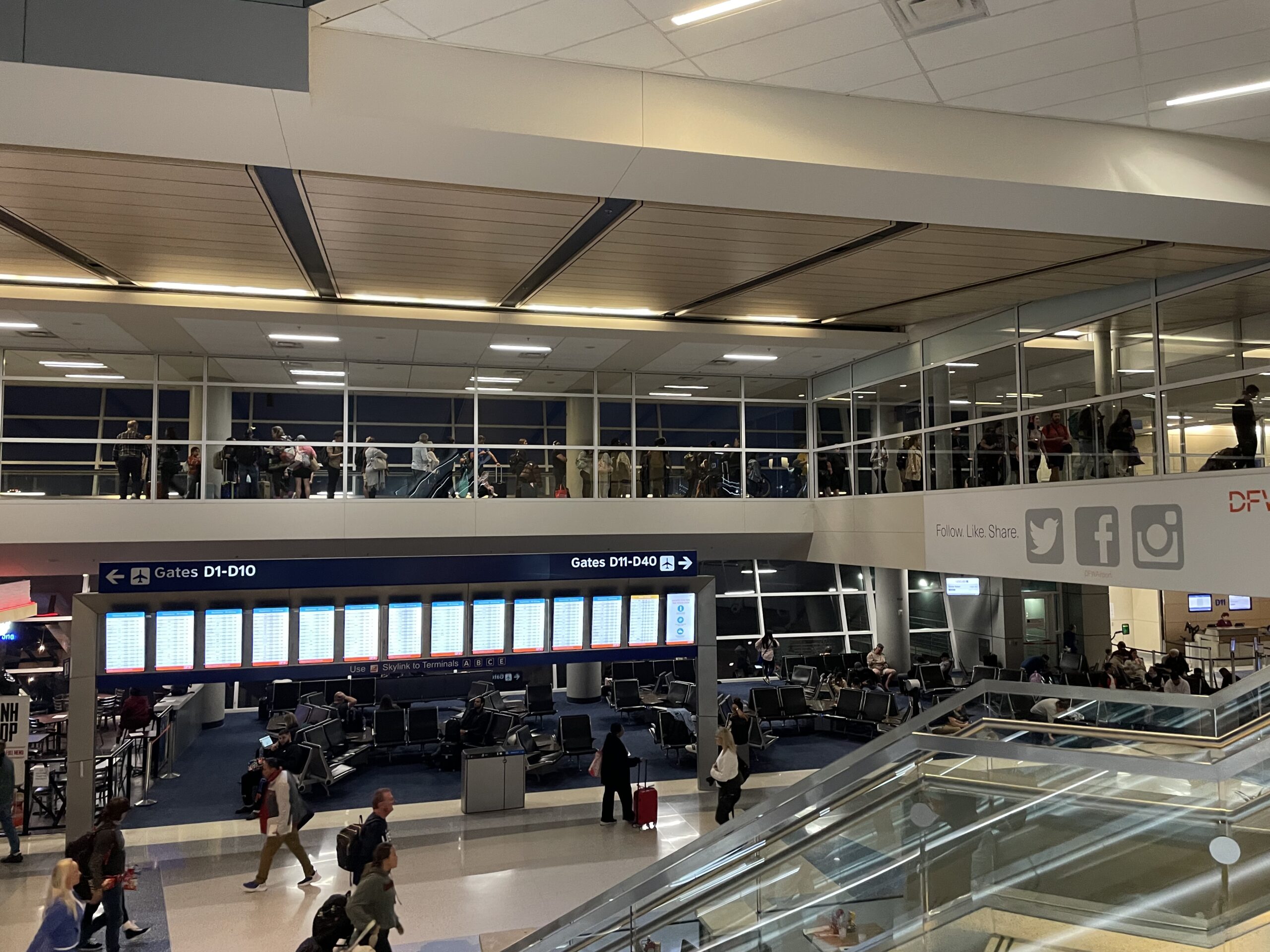
    It’s no secret that the airline industry has been a rollercoaster lately, with domestic travel taking a nosedive while international demand remains surprisingly robust. This incongruity is causing a conundrum for low-cost carriers like Spirit, who rely heavily on domestic routes. But let’s zoom in on a scene I encountered at Dallas/Fort Worth International Airport (DFW) during the Thanksgiving holiday that I don’t recall ever seeing before.

    Customs line at DFW backed up almost to the plane, (C) 2023 Points & PDBs
    That’s backed up almost to the plane!

    Now, the image I captured speaks volumes. The line for passport control snaked its way beyond the Customs and Border Protection (CBP) facility and into the sterile glass corridors used to separate arriving international passengers from those who have undergone TSA screening – really, almost to the plane passengers were getting off of (I was in a hurry and didn’t stop to figure out where they were coming from). It was a sight to behold, and it left me pondering a hypothetical scenario: What would you do in this situation?

    The line extended well before the point where it bifurcates into channels for Global Entry and Mobile Passport Control. Would you have queued up with the masses until you reached the split for Global Entry, or would you have boldly strolled past everyone straight to the Global Entry kiosks?

    Personally, I lean towards the latter. Sure, you might attract a few disapproving glances, but hear me out. The majority of those in line are likely waiting for standard screening involving an interview with a CBP officer. By skipping ahead to the Global Entry kiosks, you’re not usurping their position in the standard screening line; you’re just taking advantage of a time-saving tool – one that you’ve paid and undergone a background check and interview for. Of course, if a staff member intervenes, it’s important to comply, but don’t let the judgmental stares from fellow passengers deter you.

    Thankfully, I was a mere spectator in this spectacle (I saw this while coming down the escalator from the Skylink near gate ~D12) and didn’t have to grapple with the decision myself. DFW generally has a reputation for efficiency in both TSA and Customs screening, and I’ve never personally seen a line of this magnitude at the Texas mega-hub, whether returning to the country myself or observing from the concourse below.

    The only comparable scenario I recall was during the initial COVID lockdowns when people rushed to return home, causing delays amid heightened health screening measures. This line, however, takes the cake for its sheer length. It raises the question: Is the surge in international demand truly that substantial, or are CBP staffing issues over the holidays bottlenecking the process?

    During the pandemic, American Airlines retired numerous widebody aircraft, anticipating the delivery of new 787s to coincide with the expected rebound in demand. Unfortunately, Boeing’s delays in delivering the 787s have left AA with severely constrained international capacity at present. As most of AA’s international flights are already completely filled with either paid or standby passengers, it’s unlikely there’s suddenly a huge surge of additional passengers flying internationally on AA. It’s not like they have the ability to add a bunch of new capacity for the holiday season, save for some narrowbody flights to Mexico and the Caribbean (Canada has preclearance at most airports so that’s effectively domestic for this purpose).

    So, what would you have done in this situation?